
Mention sentiment percentages
also called Positive SERP sentiment %Negative SERP sentiment %Neutral SERP sentiment %
Definition
The proportion of a brand's results-page mentions falling into each sentiment class.
Scope, grain and dimensions
- Grain
- One domain × sentiment class × segment × period × medium.
- Dimensions
- competitor domain · intent · brand · country · device
- Required filters
- segment_id · selected_period · source_medium
- Aggregation
- Would be a proportion per domain and period; proportions are never averaged across slices without their underlying counts.
- Metric type
- rate · % of that brand's sentiment-classified mentions in the class
Data sources
Skills and analyses that use it
Skills carry the judgment; the analysis verbs do the reading.
Analysis verbs
competitive_overviewcompetitive_trends
Method rungs and levers
A rung tells you what a movement here can and cannot explain, read the rungs below it first.
levers L6 Authority & off-site
Ask Quattr
- "What share of our results-page mentions read as positive?" Simulate this →
- "How does our sentiment mix compare with a rival's?" Simulate this →
Caveats, freshness and failure modes
The denominator is NOT the brand's total mentions. The semantic layer divides by a separate sentiment-classified mention total, so the three classes sum to a hundred per cent of the classified subset and not of everything counted as a mention.
When that denominator is zero the measure returns zero rather than null, so a 0% class can mean no classified mentions at all rather than no sentiment of that kind.
Percentages at low mention volumes swing hard; without the underlying counts a sentiment mix is not interpretable.
The family is gated before any read, and the measure names are recorded in the registry as hypotheses.
Direction is class-dependent, so no single higher-is-better claim holds for the family.
- Freshness
- ~1 day behind, Daily observation, available the following day.
Common failure modes
- Quoting a sentiment percentage without the classified mention count behind it.
- Reading the percentages as a share of all mentions rather than of the classified subset.
- Comparing sentiment mixes between domains with very different mention volumes.
Not the same as
The confusions that cause the most wrong decisions.
Mention sentiment percentages Mention polarity counts Compare definitions →
These are proportions of a domain's own mentions; the polarity counts are the volumes those proportions are computed from.
Mention sentiment percentages Positive sentiment share of AI mentions Compare definitions →
Sentiment measured on SERP brand mentions is a different corpus from sentiment measured in answer-engine text. They are collected separately, on different cadences, and are not comparable.
Watch this metric read in a real run
All runs →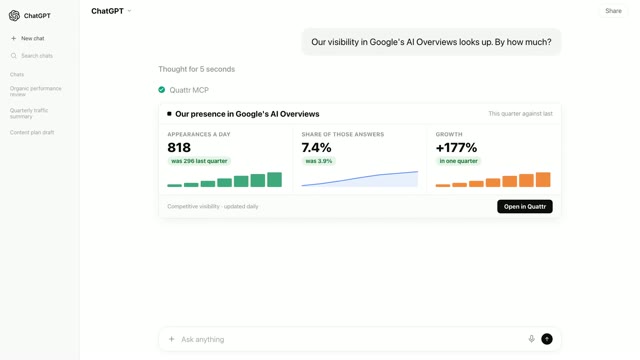
Related metrics and workflows
Verification
A definition is the smallest part of this.
The measurement matters because something acts on it. Here is the rest of the showcase, in the order most people find useful.