
Prompt share-of-voice score
also called Share of Voice scoreSoV score
Definition
A weighted points score for how much of an answer-engine prompt's voice you hold, counting each citation as 1.25 and each mention as 1.
How it's calculated
score = 1.25 × your citations for the prompt + your mentions for the prompt, rounded to a whole number. Both inputs are filtered to your own domain before the weighting is applied.
Scope, grain and dimensions
- Grain
- One prompt for one tracked segment over one date range.
- Dimensions
- prompt · answer engine · intent · branded vs non-branded · country · device
- Required filters
- tracker or tracked segment id · date range
- Aggregation
- A points total per prompt. Not comparable across segments or periods with different basket sizes, and not a component of the percentage beside it, that percentage divides this score by the same weighted total across every domain on the prompt, not by a sum of your scores.
- Metric type
- score · weighted points (citations weighted 1.25, mentions weighted 1)
Data sources
Where you'll see this
Named reports that normally include this metric.
Skills and analyses that use it
Skills carry the judgment; the analysis verbs do the reading.
Analysis verbs
ai_visibility_drilldown
Method rungs and levers
A rung tells you what a movement here can and cannot explain, read the rungs below it first.
levers L7 AI-answer visibility
Ask Quattr
- "Which prompts carry most of our AI voice?" Simulate this →
- "Where does the weighting change the ranking versus raw citations?" Simulate this →
How to read it
The weighting encodes an editorial position, a citation is worth more than a mention because it is the earned-source signal, and it is the same weighting the semantic layer applies in its own presence score, so the prompt score is a grain of an existing product quantity rather than a verb invention. Use it to order prompts, not to state a level.
Caveats, freshness and failure modes
The 1.25 weight is a product constant, not an engine-reported quantity. It matches the semantic layer's presence score, so the two agree by construction rather than by coincidence.
The prompt tab reads the market-share rank and brand-mention datasets. If the tracker has no market-share segment for the requested engine the tab returns no rows with a stated reason.
Every figure is scoped to a tracked prompt basket, a sample, not a census, so the basket's coverage belongs beside the number it produced.
Engines are non-deterministic: the same prompt can answer differently twice, so a prompt's score is an observation total over repeated runs.
- Freshness
- ~1 day behind, Daily prompt runs, available the following day.
Common failure modes
- Comparing scores between two segments or two periods whose baskets differ.
- Reading the score as a percentage, it is an unbounded points total.
Not the same as
The confusions that cause the most wrong decisions.
Prompt share-of-voice score Prompt share-of-voice percentage Compare definitions →
The score is your weighted points total on the prompt; the percentage is that total over every domain's weighted total on the same prompt. Both are well defined and neither is derived from the other by summing prompts.
Prompt share-of-voice score AI share of voice Compare definitions →
The same weights at two grains: this is computed in the verb from one prompt's counts, while the grid and competitor tabs read a semantic-layer measure over the whole slice.
Watch this metric read in a real run
All runs →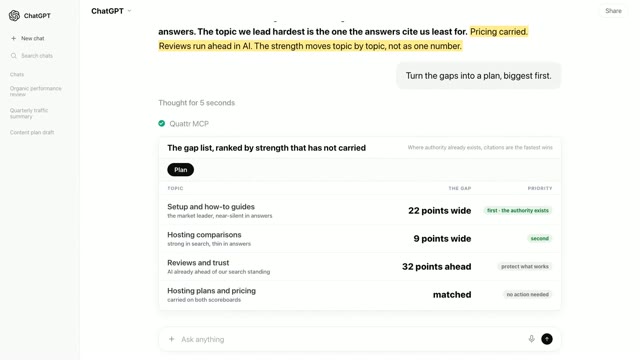
Related metrics and workflows
Verification
A definition is the smallest part of this.
The measurement matters because something acts on it. Here is the rest of the showcase, in the order most people find useful.