
Prompt share-of-voice percentage
also called Share of Voice % (prompts tab)
Definition
Your share of the weighted voice on one answer-engine prompt: your citations and mentions, weighted, as a percentage of every cited domain's citations and mentions on that same prompt.
How it's calculated
(1.25 × your citations for the prompt + your mentions for the prompt) ÷ (1.25 × all domains' citations for the prompt + all brands' mentions for the prompt) × 100, returned empty when the prompt drew no weighted voice at all.
- Numerator
- Your weighted voice on the prompt, citations at 1.25, mentions at 1.
- Denominator
- The same weighted combination across every cited domain and named brand on that prompt.
Scope, grain and dimensions
- Grain
- One prompt for one tracked segment over one date range.
- Dimensions
- prompt · answer engine · intent · branded vs non-branded · country · device
- Required filters
- tracker or tracked segment id · date range
- Aggregation
- Each prompt carries its own denominator, so these do not average into an account-level share and do not sum to a hundred down the column.
- Metric type
- share · percent of that prompt's weighted voice
Data sources
Where you'll see this
Named reports that normally include this metric.
Skills and analyses that use it
Skills carry the judgment; the analysis verbs do the reading.
Analysis verbs
ai_visibility_drilldown
Method rungs and levers
A rung tells you what a movement here can and cannot explain, read the rungs below it first.
levers L7 AI-answer visibility
Ask Quattr
- "What share of voice do we hold on this prompt?" Simulate this →
How to read it
A competitive standing on one prompt, comparable in kind to the citation and mention shares beside it. Because it folds two behaviours together under fixed weights, a move is a prompt to read the citation and mention columns rather than a finding on its own.
Caveats, freshness and failure modes
The 1.25 and 1.0 weights are a product decision, not a quantity any engine reports. They match the semantic layer's own presence score, so the prompt figure and the account figure weight the same way.
When the all-domain legs return no rows for a prompt, both sides of the ratio fall back to your own totals and the share reads as one hundred percent. On a thin prompt, check the prompt's citation and mention totals before reading it as dominance.
The same column label appears on the competitor, intent, geography and brand tabs carrying a semantic-layer measure computed over the whole slice rather than per prompt. Same weights, different population.
The prompt tab reads the market-share rank and brand-mention datasets. If the tracker has no market-share segment for the requested engine the tab returns no rows with a stated reason.
Every figure is scoped to a tracked prompt basket, a sample, not a census, so the basket's coverage belongs beside the number it produced.
- Freshness
- ~1 day behind, Daily prompt runs, available the following day.
Common failure modes
- Comparing a prompt's figure here against the same-named figure on the competitor tab, which is computed over the whole slice.
- Averaging per-prompt shares into an account-level share of voice.
- Reading a hundred-percent share on a low-volume prompt without checking whether the all-domain legs returned anything.
Not the same as
The confusions that cause the most wrong decisions.
Prompt share-of-voice percentage Per-prompt citation share Compare definitions →
Neighbouring columns over the same prompt population, differing in what they count. The citation share divides your prompt citations by every cited domain's citations; this divides your weighted citations-plus-mentions by the same weighted total.
Prompt share-of-voice percentage Prompt share-of-voice score Compare definitions →
The score is your weighted points total on the prompt; this is that total over the prompt's weighted total across all domains. The score rises with volume, the share does not.
Prompt share-of-voice percentage AI share of voice Compare definitions →
Same weights, two grains and two implementations: the grid and competitor tabs read a semantic-layer measure over the whole slice, this is computed in the verb per prompt. Neither decomposes into the other.
Prompt share-of-voice percentage Per-prompt mention share Compare definitions →
The mention share divides by all tracked brands' mentions on the prompt; this divides the same population's weighted citations-plus-mentions, so it moves with the citation half too.
Watch this metric read in a real run
All runs →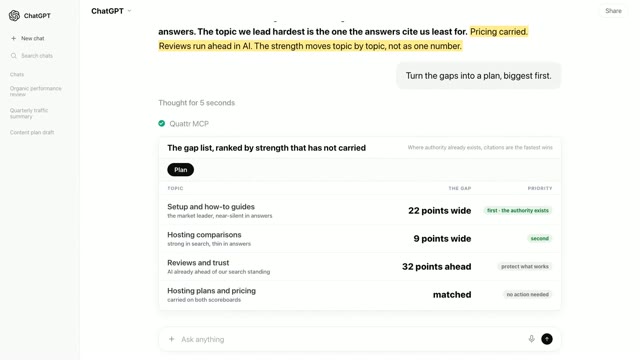
Related metrics and workflows
Verification
A definition is the smallest part of this.
The measurement matters because something acts on it. Here is the rest of the showcase, in the order most people find useful.