
Spearman correlation
also called Spearman rhoRank correlation
Definition
How closely two metrics move together in rank order, over aligned time buckets.
How it's calculated
Both aligned series are converted to ranks, with tied values sharing an average rank, and the product-moment coefficient is then computed on those ranks, it is literally the value-based routine applied to ranks. The probability is produced the same way too, which means it inherits the same normal approximation rather than an exact distribution.
Scope, grain and dimensions
- Grain
- One value per metric pair, date range and bucket size.
- Dimensions
- bucket
- Required filters
- date_range
- Aggregation
- One coefficient per pair of series.
- Metric type
- statistical verdict · coefficient between −1 and 1
Data sources
Skills and analyses that use it
Skills carry the judgment; the analysis verbs do the reading.
Analysis verbs
correlate_domains
Method rungs and levers
A rung tells you what a movement here can and cannot explain, read the rungs below it first.
Ask Quattr
- "Do citations and sessions move together?" Simulate this →
- "Is the relationship robust to outliers?" Simulate this →
How to read it
The robust reading of the same question. Because it works on ranks, a single extreme week cannot dominate it and a real but curved relationship still shows. When the two coefficients disagree sharply, that disagreement is itself the finding.
Caveats, freshness and failure modes
Its significance carries the same approximation as the value-based coefficient: a normal approximation with a Cornish to Fisher correction, anti-conservative on short series and never stated on the card. It is also the standard coefficient's probability formula applied to ranks, which is a further approximation on top.
Correlation is not causation; the same caveat and sample size ride on the payload.
Ranking discards magnitude, so a relationship that is strong in rank order can be small in absolute terms.
Ties share an average rank, which flattens the coefficient on series with many repeated values.
Same minimum of three buckets per side and three aligned buckets as the value-based coefficient.
An insignificant coefficient is reported as no detectable relationship at this power.
- Freshness
- varies by site, priority URLs can run nightly; most pages far less often. The collection date rides on the card rather than being assumed.
Common failure modes
- Reading rank agreement as proportional movement.
- Reporting whichever of the two coefficients is larger without saying which was used.
Not the same as
The confusions that cause the most wrong decisions.
Spearman correlation Pearson correlation Compare definitions →
Spearman works on ranks and Pearson on values. Where they disagree, the relationship is either non-linear or outlier-driven, and reporting only one hides that.
Watch this metric read in a real run
All runs →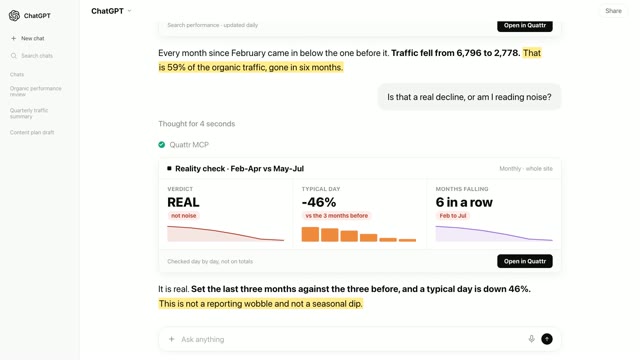 2 min 5 secTraffic more than halved in six months. Nobody could say why.Search Console · Anomaly investigator◐Recreated from an anonymized session
 3 min 4 secThe fix shipped. Traffic rose. Now two teams want the credit.Lighthouse + Search Console + Rank tracking · Significance referee · Cross domain correlator◐Recreated from an anonymized session
Related metrics and workflows
Metrics
Verification
A definition is the smallest part of this.
The measurement matters because something acts on it. Here is the rest of the showcase, in the order most people find useful.